
IFU ! Tracheostomy Tube Cuffed ! Medisafe International
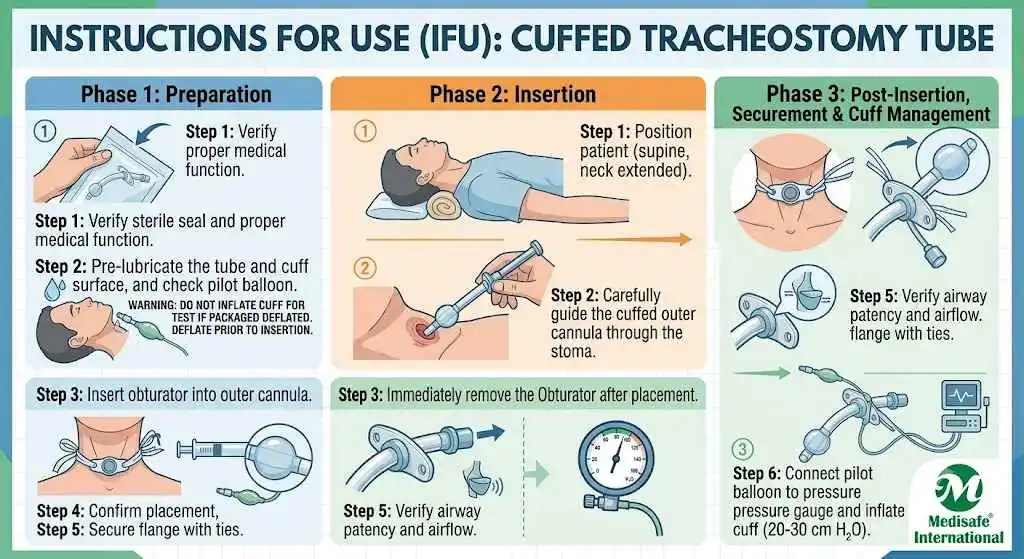
The complete, step-by-step Instructions for Use (IFU) for the Cuffed Tracheostomy Tube, structured for clinical documentation and marketing collateral:
Instructions for Use (IFU): Cuffed Tracheostomy Tube
Product Description
The Cuffed Tracheostomy Tube is a sterile, single-patient-use airway device inserted into the tracheostoma to establish and maintain airway patency. It features a low-pressure, high-volume inflatable cuff designed to create a positive tracheal seal for mechanical ventilation and aspiration protection.
Phase 1: Preparation & Pre-Use Inspection
-
Verify Package Integrity: Check the sterile pouch prior to opening to confirm the sterile seal is intact and undamaged.
-
Visual Inspection: Inspect the outer cannula, neck flange, inner cannula, obturator, pilot balloon, and cuff for any visual defects.
-
Cuff Test & Pre-Lubrication:
-
Attach a syringe to the one-way inflation valve on the pilot balloon and inflate the cuff to verify balloon integrity and check for air leaks.
-
Fully deflate the cuff using the syringe prior to insertion.
-
Apply a thin layer of water-soluble medical lubricant to the tube shaft, cuff surface, and obturator tip.
-
-
Assembly: Insert the inner cannula (if applicable) and secure the obturator into the outer cannula.
Phase 2: Insertion Procedure
Note: Insertion must be performed by a qualified medical professional using standard aseptic technique.
-
Patient Positioning: Position the patient supine with the neck extended to allow clear visualization of the tracheostoma.
-
Tube Insertion: Carefully guide the lubricated cuffed tube assembly through the stoma into the trachea following its natural curve.
-
Immediate Obturator Removal: Hold the neck flange firmly against the neck and immediately withdraw the obturator to clear the airway.
Phase 3: Post-Insertion, Securement & Cuff Management
-
Confirm Airway Placement: Verify tube positioning and airflow via chest rise, auscultation of bilateral breath sounds, or capnography.
-
Secure the Flange: Secure the neck flange firmly to the patient’s neck using dedicated tracheostomy ties or a collar to prevent accidental decannulation.
-
Cuff Inflation & Pressure Monitoring:
-
Attach a pressure gauge (manometer) or syringe to the pilot balloon valve and inflate the cuff.
-
Adjust and maintain cuff pressure within the recommended safe clinical range (typically 20–30 cm H₂O) to avoid tracheal mucosa damage or air leaks.
-
Indications & Care Guidelines
-
Primary Indications: Intended for patients requiring mechanical ventilation, positive pressure support, or protection against aspiration.
-
Maintenance: Regularly inspect and clean/replace the inner cannula and maintain stoma hygiene according to clinical protocol.
-
Wear Limit & Replacement: Follow medical guidelines and institutional policies (typically up to a 30-day wear limit for single-patient devices).
-
Speech Note: Speaking requires the cuff to be fully deflated under qualified clinical supervision before attaching a speaking valve.