
IFU ! Antistatic Face Mask
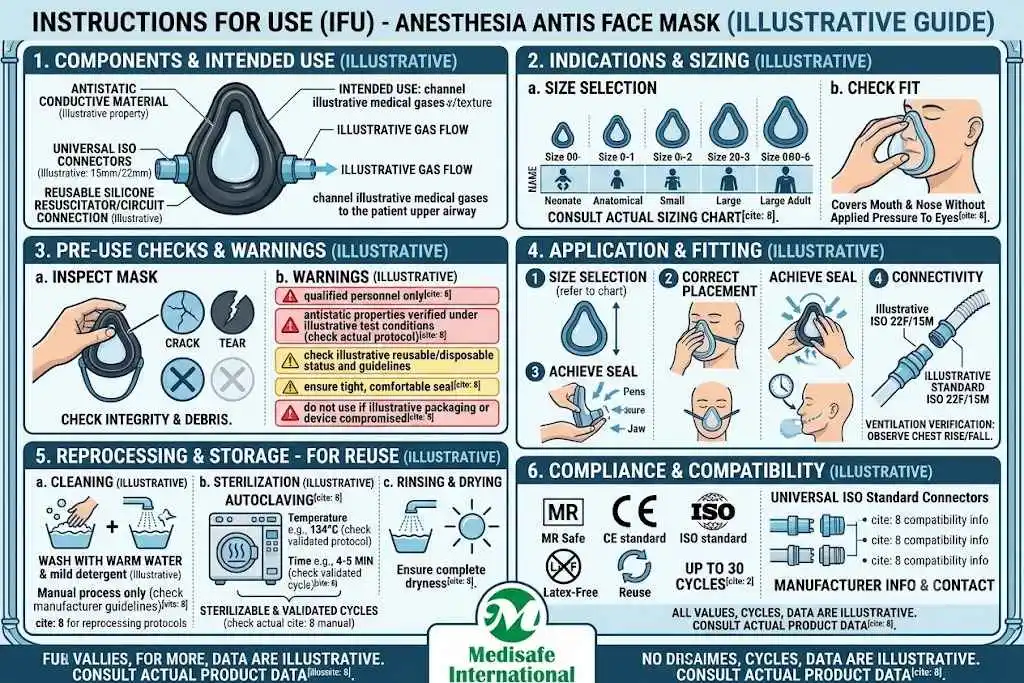
Instructions for Use (IFU) ! Anesthesia Antistatic Face Masks ! Medisafe International
1. INDICATIONS FOR USE (Intended Use)
The Medisafe International Anesthesia Antistatic Face Mask is a non-invasive patient interface designed to channel oxygen, anesthesia gases, or air mixtures from a breathing circuit or manual resuscitator directly to the patient’s upper airway.
Engineered with conductive materials, this mask safely dissipates electrostatic charges to prevent static buildup and spark hazards in high-oxygen operating room (O.R.) environments.
2. PRODUCT DESCRIPTION & TECHNICAL SPECIFICATIONS
- Antistatic Conductive Construction: Manufactured from medical-grade conductive rubber or specialized carbon-filled antistatic silicone to provide a continuous conductive path for electrostatic discharge.
- Anatomical Cushion: Soft, contoured sealing rim designed to conform to facial anatomy for an airtight seal with minimal downward pressure.
- Standardized Connectors: Equipped with universal 15 mm or 22 mm ISO 5356-1 conical fittings for seamless compatibility with anesthesia circuits and manual resuscitators.
Biocompatibility: 100% Latex-Free and biocompatible per ISO 10993 standards.
Reusability: Validated for multi-patient reuse (up to 30 autoclave cycles) following proper cleaning and sterilization
3. SIZING GUIDE
Select the appropriate anatomical size that completely covers the patient's nose and mouth without applying pressure to the eyes or extending past the chin.
|
Size |
Patient Category |
Connector Standard |
|
Size 00 / 0 |
Neonate / Small Infant |
15 mm |
|
Size 1 |
Infant |
15 mm |
|
Size 2 |
Pediatric / Child |
15 mm |
|
Size 3 |
Small Adult / Large Child |
15 mm |
|
Size 4 |
Medium Adult |
15 mm |
|
Size 5 / 6 |
Large Adult |
15 mm |
4. WARNINGS & PRECAUTIONS
- Qualified Personnel Only: For use strictly by trained healthcare professionals proficient in airway management and anesthesia delivery.
- Conductivity Verification: Antistatic properties (electrical resistance) must be tested periodically per institutional safety protocols using a calibrated resistance meter. Discard immediately if resistance exceeds safe limits.
- Ocular & Tissue Protection: Do not apply excessive downward force or allow the mask rim to rest on the patient's eyes, as this can cause corneal abrasion or trigger the oculocardiac reflex.
- Pre-Use Integrity Check: Never use a mask exhibiting cracks, tears, surface stickiness, or a deformed cushion.
- Cross-Contamination Risk: Do not reuse on another patient without completing full cleaning and validated steam sterilization.
5. APPLICATION & FITTING PROTOCOL
- Pre-Use Inspection: Examine the mask dome, cushion, and connector hub for debris, cracks, or structural deformation.
- Circuit Connection: Firmly attach the $15 mm or 22 mm ISO connector to the breathing circuit elbow or resuscitator patient valve.
- Placement: Position the apex of the mask gently over the bridge of the patient's nose, then lower the base smoothly over the chin.
- EC Clamp Seal: Form a "C" with your thumb and index finger over the mask collar to apply even downward pressure, while using your remaining three fingers ("E") to lift the mandible upward into the cushion.
- Ventilation Verification: Initiate ventilation and confirm an airtight seal by observing symmetrical chest rise and fall, capnography waveforms, and reservoir bag movement.
6. REPROCESSING, STERILIZATION & STORAGE
A. Manual Cleaning
- Disassembly: Remove the detachable hook ring (if fitted).
- Wash: Submerge the mask in warm water with a mild, neutral-pH enzymatic detergent. Scrub all surfaces and connector lumens gently using a soft-bristled brush.
- Rinse & Dry: Rinse thoroughly with purified water to remove all detergent traces, then air dry completely or wipe with a lint-free cloth.
B. Autoclave Sterilization (Validated Parameters)
- Method: Pre-vacuum or Gravity Displacement Steam Autoclave.
- Temperature: 134 ° C.
- Hold Time: 4 to 5 minutes (134 ° C. for 15–20 minutes).
- Caution: Avoid phenol-based disinfectants, harsh solvents, or radiation sterilization, as these degrade conductive elastomers.
C. Storage & Service Life
- Storage: Store clean, dry masks in protective packaging in a cool, dark environment away from direct sunlight, ozone sources, and extreme temperatures. Do not stack heavy items on masks to prevent cushion deformation.
- Service Life: Replace after 30 sterilization cycles or immediately upon failing conductivity testing or visual inspection.