
FAQ : Peep Valve for Ambu Bag ! Disposable and Reusable
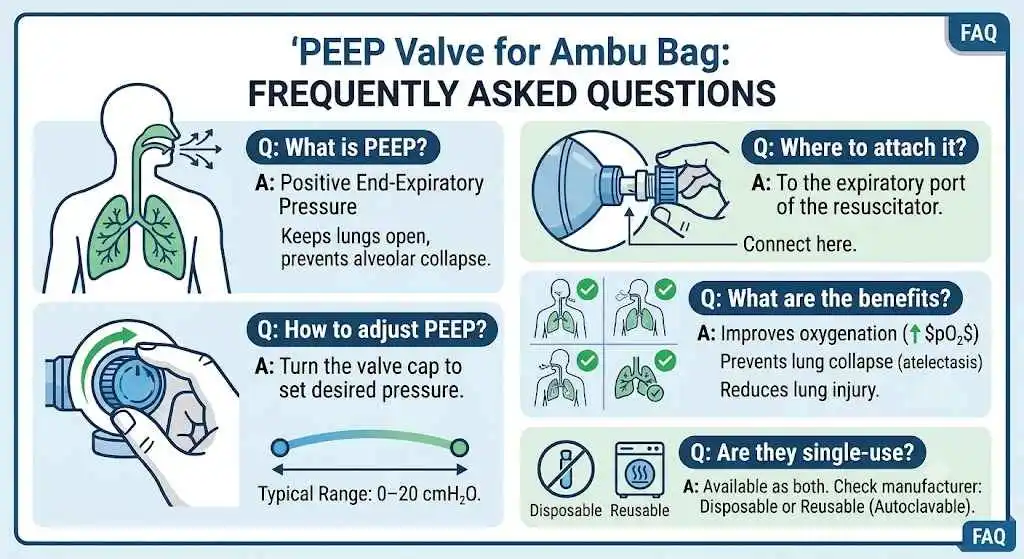
What is a PEEP Valve, and how does it work with a manual resuscitator?
A Positive End-Expiratory Pressure (PEEP) Valve is a spring-loaded mechanical control device attached to the exhalation port of a Manual Resuscitator (BVM or Ambu Bag).
During manual ventilation, the PEEP valve maintains a preset level of positive pressure in the patient's lungs at the end of the exhalation phase. By preventing airway pressure from dropping to atmospheric level, it stops alveoli from collapsing (atelectasis), increases functional residual capacity (FRC), and significantly improves arterial oxygenation (pAo2)
Technical Specifications Matrix
| Parameter | Specification / Performance Standard |
| Adjustable Pressure Range |
0-20 cm cmH2O (Calibrated dial markings) |
| Connector Fitting |
30-15 mm Female/ 22 mm ISO adopter (Direct fit to resuscitator divertor) |
| Adaptor Options |
ISO Conical Adaptors |
| Material Construction | Polycarbonate housing with stainless steel spring and medical silicone disk |
| Reprocessing Options |
Single-Use (Disposable) OR Reusable (Autoclavable at 134^) |
| Biocompatibility |
100 % Latex-Free, Phthalate-Free (ISO 10993 compliant) |
Q1: Where exactly is the PEEP valve attached to an Ambu bag?
The PEEP valve must be attached to the expiratory port (exhalation exit) of the patient valve assembly. If the resuscitator features a splash guard or exhalation divertor, remove or align it to connect the standard 30 mm female fitting of the PEEP valve directly onto the port.
Q2: Why is a PEEP valve essential during emergency ventilation?
Without a PEEP valve, the pressure in the lungs drops to cm H2O at the end of exhalation, leading to complete alveolar collapse in compromised lungs (e.g., ARDS, severe pneumonia, pulmonary edema, drowning, or hypoxemia). Using a PEEP valve
- Keeps small airways open throughout the entire respiratory cycle.
- Enhances gas exchange and oxygen saturation SPO2
- Reduces atelectrauma (damage caused by repeated collapsing and re-opening of alveoli
Q3: How do you adjust and set the PEEP level?
- Locate the calibrated cap/dial on top of the PEEP valve housing
- Rotate the dial clockwise to increase resistance (raise PEEP setting) or counter-clockwise to lower resistance.
- Align the indicator line with the desired numeric pressure marking (e.g., cmH2O)
- Clinical Tip: Always verify actual PEEP levels using an in-line airway pressure manometer during ventilation.