
FAQ ! Anaesthesia Antistatic Face Mask
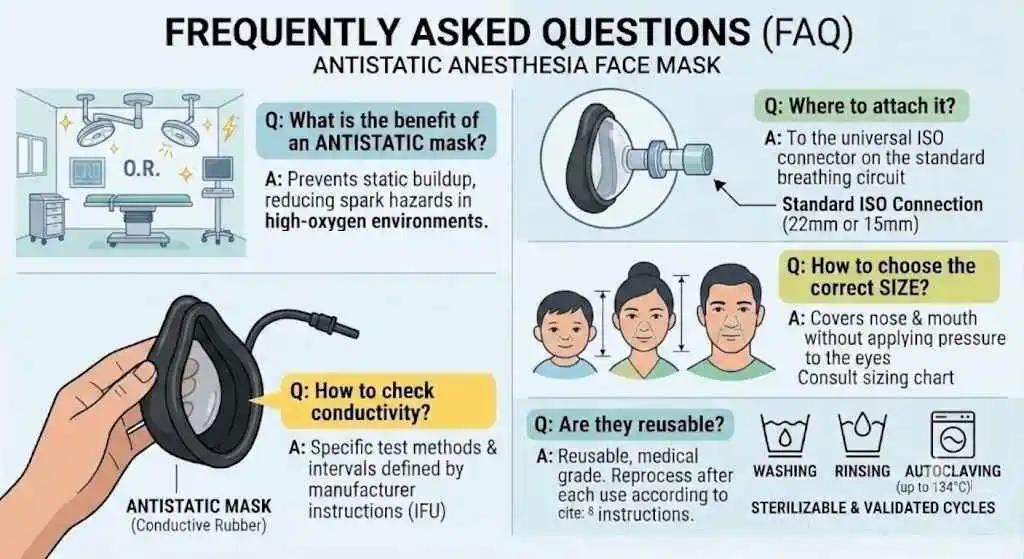
Frequently Asked Questions (FAQ): Anesthesia Antistatic Face Mask
1. What is an Anesthesia Antistatic Face Mask?
An Anesthesia Antistatic Face Mask is a patient interface device designed to cover the patient’s nose and mouth during the administration of anesthesia gases. It is specifically engineered to control and safely dissipate electrostatic charges, preventing the buildup of static electricity on the mask’s surface.
2. Why is the antistatic feature necessary in an operating room?
Static electricity buildup in the operating room environment poses several critical risks.
- Ignition Hazard: Sparks generated by static discharge could ignite flammable anesthetic agents (historically more common with agents like ether, but still a consideration for high-oxygen environments and potential vapors.
- Electrical Interference: Static electricity can cause interference or malfunctions in sensitive electronic monitoring equipment.
- Microbial Attractance: Static charges can attract dust and airborne microorganisms to the mask, increasing the risk of contamination.
3. How does the mask achieve its antistatic properties?
The masks are constructed using conductive materials or specialized additives integrated into the mask composition (such as conductive rubber or specialized carbon-filled silicone).These materials facilitate a continuous conductive path, allowing any accumulated static charge to be safely bled off and dissipated to the ground rather than building up.
4. What materials are typically used for these masks?
Antistatic masks are commonly made from two types of medical-grade materials:
- Conductive Rubber: Traditionally these are black masks.
- Conductive/Specialized Silicone: Modern antistatic silicone masks can be translucent, allowing for easier patient monitoring (e.g., observing skin color, secretions, or fogging from exhalation).
5. Are Anesthesia Antistatic Face Masks reusable?
Yes, most Anesthesia Antistatic Face Masks are designed for reuse across multiple patients. However, this requires rigorous cleaning and sterilization (reprocessing) between each use to prevent cross-contamination. You must always verify the mask is validated for reusability in its Instructions for Use (IFU).
6. How are these masks cleaned and sterilized (reprocessed)?
The recommended reprocessing steps must be strictly followed according to the manufacturer's validated IFU. A general procedure typically involves.
- Manual Cleaning: Washing the mask immediately after use with warm water and a neutral-pH enzymatic detergent, using a soft brush.
- Rinsing: Thoroughly rinsing with purified or potable water.
- Sterilization: The preferred method is typically high-temperature steam sterilization (autoclaving). Validated parameters often include:
- Temperature: 134 ° C (273 ° F)
- Exposure Time: 4 to 5 minutes
7. How do I know if the antistatic property is still effective?
Conductive masks should be periodically checked with a resistance meter (multimeter) according to the manufacturer's specified procedure to ensure their conductivity (resistance) remains within the safe ranges defined by standards (e.g., ISO and ASTM standards related to anesthetic equipment safety). A significant increase in resistance indicates the mask may no longer be effective at dissipating static electricity and must be replaced.
8. What are standard connectors for these masks?
Antistatic masks, like standard anesthesia masks, feature ISO standard conical connectors ($15\text{ mm}$ or $22\text{ mm}$ fittings per ISO 5356-1) to ensure compatibility with standard breathing circuits, manual resuscitators, and other anesthesia delivery systems.
9. Are there different sizes available? How do I ensure a correct fit?
Yes, masks are available in a full range of anatomical sizes, typically from neonatal (Size 00) to large adult (Size 6).
- Sizing: Choose a size that covers the patient's nose and mouth completely without encroaching on the eyes or extending below the chin.
- Fit: To create an airtight seal, a trained clinician uses a technique such as the EC Clamp Maneuver (forming a "C" with the thumb and index finger over the mask dome and an "E" with the remaining three fingers along the mandible)
10. How should these masks be stored?
When not in use, cleaned and sterilized masks should be stored in a clean, dry, cool place, protected from direct sunlight and extreme temperatures, ideally in protective packaging[cite: 8]. Avoid storing them in a deformed state, as permanent distortion may occur and affect functionality.
11. What is the expected lifespan of a reusable antistatic mask?
The lifespan varies significantly by product, frequency of use, and adherence to reprocessing protocols. Some masks are validated for a specific number of autoclave cycles (e.g., 20–30 cycles). Refer to the manufacturer’s specifications. Replace the mask immediately if there are signs of degradation:
- Surface tackiness or stickiness.
- Cracks, tears, or deformations in the seal.
- Clouding or severe yellowing (for transparent silicone).
- Failure to pass resistance (conductivity) testing.
Disclaimer: The following information is a general Frequently Asked Questions (FAQ) guide for Anesthesia Antistatic Face Masks. For specific product details, technical specifications, or cleaning protocols, always refer to the manufacturer’s Instructions for Use (IFU) and follow institutional guidelines