
IFU ! Tracheostomy Tube Uncuffed
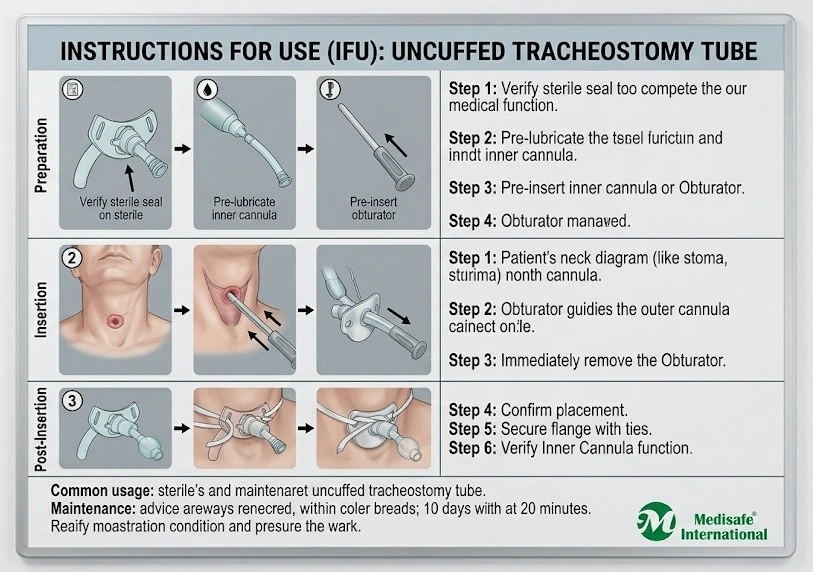
Instructions for Use (IFU): Uncuffed Tracheostomy Tube
The Uncuffed Tracheostomy Tube is a sterile, single-patient-use device inserted into a tracheostoma to establish and maintain an open airway. It is designed for spontaneously breathing patients who do not require mechanical ventilation or cuff-assisted aspiration protection.
Phase 1: Preparation & Inspection
Verify Package Integrity: Inspect the sterile pouch prior to opening. Do not use if the package seal is damaged, broken, or expired.
Visual Inspection: Verify correct tube sizing and examine the device, obturator, and accessories for any visual defects.
Pre-Lubrication: Apply a water-soluble medical lubricant to the distal tip of the outer cannula, inner cannula, and obturator to facilitate smooth insertion.
Assembly: Insert the obturator fully into the outer cannula until the tip extends beyond the distal end.
Phase 2: Insertion Procedure
Note: Insertion must be performed by a qualified healthcare professional using standard aseptic technique.
Patient Positioning: Position the patient in a supine position with the neck slightly extended to ensure optimal visualization of the stoma.
Stoma Preparation: Clean and inspect the stoma site.
Tube Insertion: Gently insert the pre-lubricated assembly (outer cannula with obturator) into the stoma following the natural curvature of the trachea.
Remove Obturator Immediately: As soon as the outer cannula is positioned within the trachea, hold the neck flange firmly and immediately remove the obturator to open the airway.
Phase 3: Post-Insertion & Maintenance
Confirm Airway Placement: Verify correct placement and patency by confirming chest rise, bilateral breath sounds, and airflow through the tube.
Secure the Tube: Fasten the neck flange securely to the patient's neck using tracheostomy ties or a dedicated collar to prevent accidental decannulation.
Insert Inner Cannula: Slide the inner cannula into the outer cannula until it locks into place. Verify airflow and patency.
Routine Care: Clean or replace the removable inner cannula regularly according to facility protocol to prevent secretion buildup. Maintain stoma hygiene and clean surrounding skin daily.
Indications & Care Guidelines
Primary Application: For spontaneously breathing patients with a mature stoma who do not require positive-pressure ventilation.
Speech Capabilities: Facilitates easier natural speech and compatibility with speaking valves (e.g., Passy Muir Valve) as air passes freely around the tube.
Cleaning & Storage: Disposable inner cannulas should be replaced per schedule; reusable models must be cleaned according to institutional guidelines.