
FAQ ! Frequently Asked Question ! Cuffed Tracheostomy Tubes
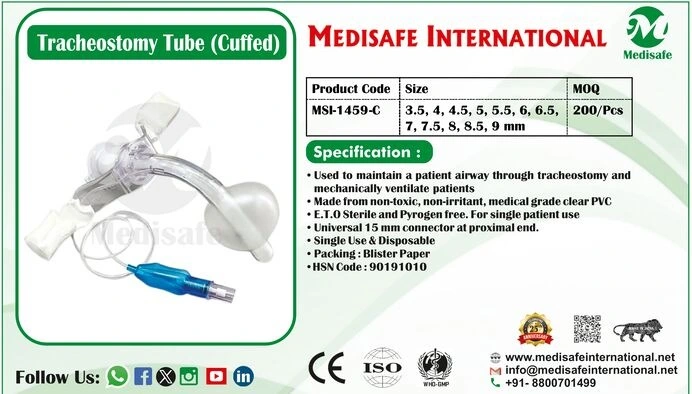
This FAQ provides comprehensive answers to common questions about Cuffed Tracheostomy Tubes. It addresses their usage, key features, management, and essential safety considerations.
1. What is a Cuffed Tracheostomy Tube?
A cuffed tracheostomy tube is a specialized medical device inserted into the trachea (windpipe) that features an inflatable balloon (cuff) near its lower tip. This cuff can be inflated to create a secure seal between the outer wall of the tube and the inner wall of the trachea.
2. Why is a Cuffed Tracheostomy Tube used?
The clinical team chooses a cuffed tube when a patient requires:
-
Mechanical Ventilation: To ensure all air delivered by the ventilator goes directly into the lungs and does not escape around the tube.
-
Aspiration Protection: To create a physical barrier that prevents secretions, saliva, food, or gastric contents from entering the lungs (aspiration).
3. What are the key components of a Cuffed Tracheostomy Tube?
In addition to standard components (outer cannula, neck flange, inner cannula, and obturator), a cuffed tube uniquely includes:
-
The Cuff: The inflatable balloon near the distal tip.
-
The Pilot Balloon: A small external balloon connected to the cuff by a fine inflation line.
-
One-Way Inflation Valve: Located on the pilot balloon, it allows air to enter but prevents it from escaping.
-
Inflation Line: The narrow tube that guides air from the valve to the cuff.
4. How is the Cuff Managed and Monitored?
Proper cuff management is critical to prevent complications.
-
Inflation and Deflation: The cuff is inflated using a syringe attached to the inflation valve. It must be deflated as per clinical instructions, especially during certain procedures or when weaning from the ventilator.
-
Pressure Monitoring: Cuff pressure must be checked regularly (e.g., every 8 hours) using a cuff pressure gauge (manometer) to ensure it is in the safe range (typically 20-30 cm H₂O).
-
Risks of Incorrect Pressure:
-
Under-Inflation: Allows air leaks (reducing ventilator efficiency) and increases the risk of aspiration.
-
Over-Inflation: Can cause pressure necrosis, tracheal damage, or obstruction of the airway.
-
5. Can a patient with a Cuffed Tube speak or eat?
-
Speaking: Speaking is typically not possible while the cuff is fully inflated, as no air can travel up past the tube to the vocal cords. Speaking valves (like the Passy Muir Valve) require the cuff to be fully deflated.
-
Eating: Eating may be difficult or impossible while the cuff is inflated, depending on the patient's condition. The decision on when and what to eat is made by a specialized team, often including a speech-language pathologist.
6. What should be done in case of a problem?
-
Cuff Leak: If the pilot balloon is flat or a patient can speak easily when they shouldn't be able to, the cuff may have a leak. This requires immediate clinical assessment.
-
Pilot Balloon Issues: If the pilot balloon feels abnormally tense or cannot be deflated, it may indicate over-inflation or a valve issue. Seek immediate medical attention.
7. When is a Cuffed Tube typically replaced?
The frequency of tube replacement varies, but healthcare providers often follow standard protocols (e.g., every 29 days for a non-disposable tube). Replacing the inner cannula (if applicable) is done more frequently as per the Instructions for Use (IFU).
Disclaimer: This FAQ is for informational purposes only and does not replace professional medical advice. Always consult a qualified healthcare provider for diagnosis, treatment, and instructions related to the use of a tracheostomy tube.